Thoughts from the operating room, the laboratory, and the spaces in between — on medicine, science, and the human condition. Short entries; occasionally a figure or a link worth sharing.
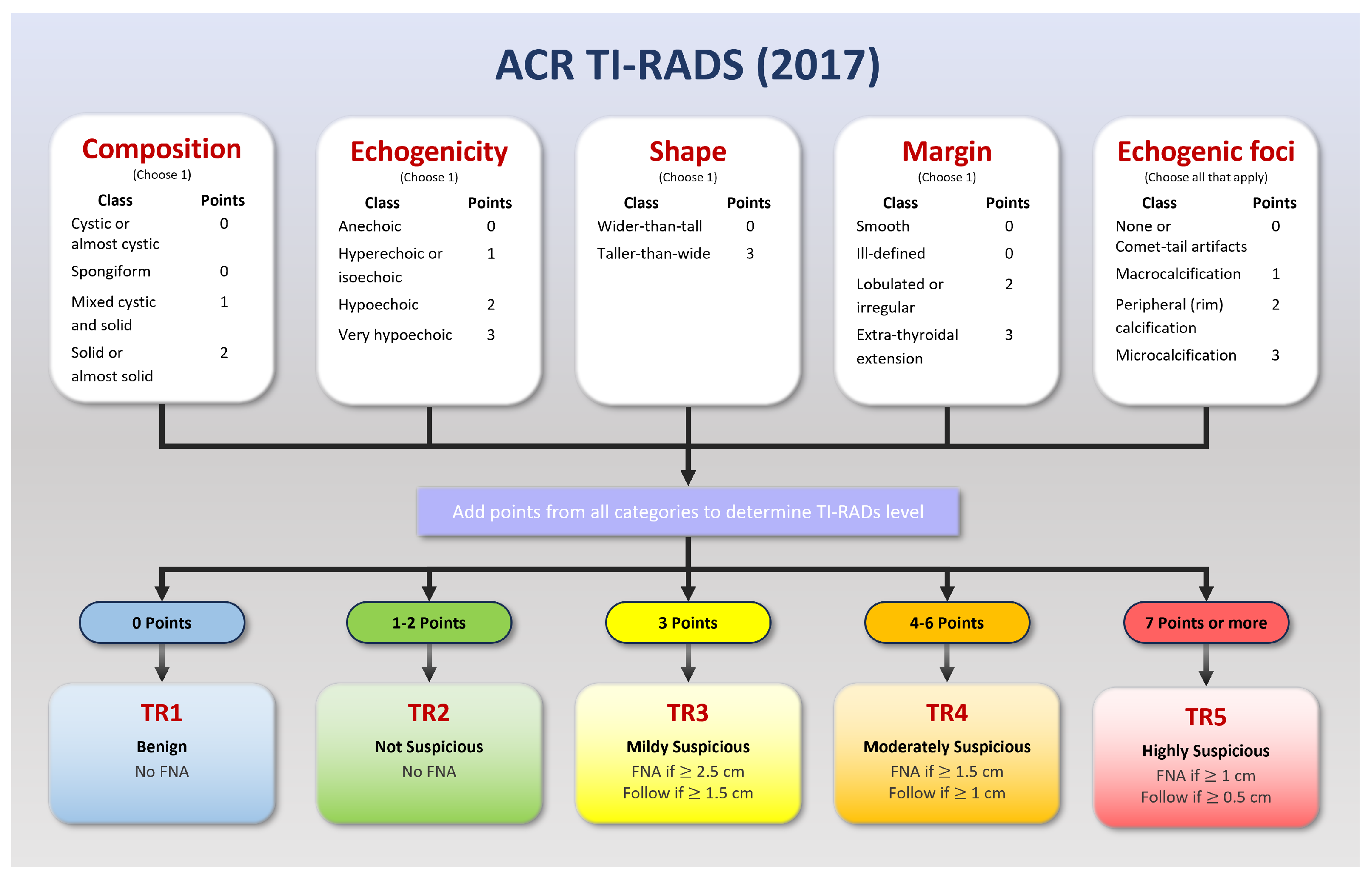
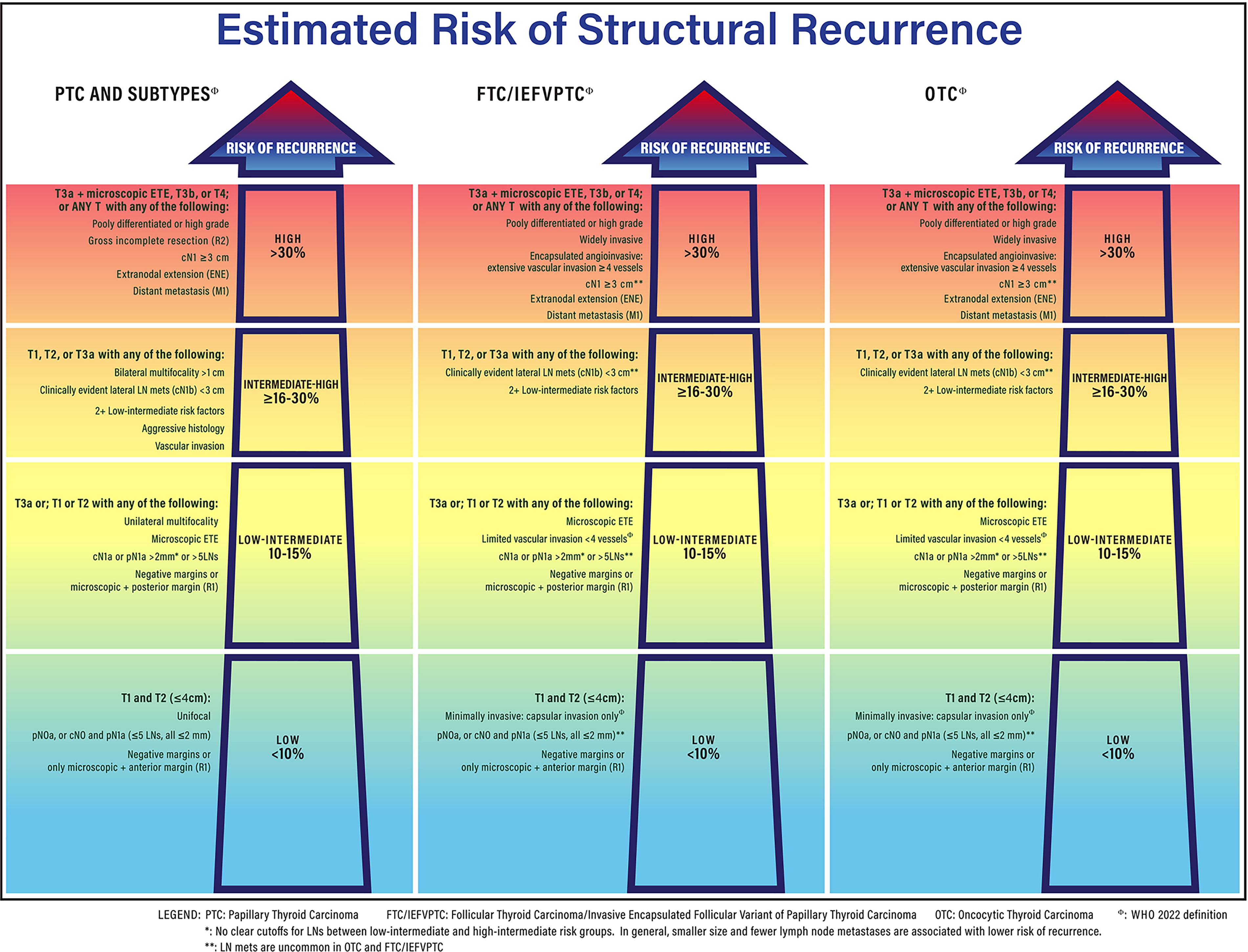
Bethesda System for Reporting Thyroid Cytopathology (TBSRTC), 3rd edition (2023) — case distribution, risk of malignancy (ROM), and management:
| Category | Diagnostic category | Approx. distribution* | ROM — 2023 (mean, range) | Usual management |
|---|---|---|---|---|
| I | Nondiagnostic / Unsatisfactory | ~5–15% | 13% (5–20%) | Repeat US-guided FNA |
| II | Benign | ~60–70% | 4% (2–7%) | Clinical & sonographic follow-up |
| III | Atypia of Undetermined Significance (AUS)† | ~5–15% (target ≤10%) | 22% (13–30%) | Repeat FNA, molecular testing, or diagnostic lobectomy |
| IV | Follicular Neoplasm (FN)‡ | ~5–10% | 30% (23–34%) | Molecular testing or diagnostic lobectomy |
| V | Suspicious for Malignancy (SFM) | ~3–5% | 74% (67–83%) | Lobectomy or near-total thyroidectomy |
| VI | Malignant | ~5–7% | 97% (97–99%) | Lobectomy or total thyroidectomy per tumor type/risk |
RLN reconstruction — immediate reinnervation at the time of thyroid cancer resection:
Preoperative Lugol's solution for Graves': decreases vascularity and blood loss; may decrease hypoparathyroidism and nerve injury rates.
RLN monitoring studies:
Neoadjuvant selective RET inhibitor (selpercatinib) for medullary thyroid cancer — emerging data from case series and ongoing trials:
Japanese approach to MTC: lobectomy with central and lateral dissection is permitted for sporadic, non-RET disease in select patients:
Genetic alterations by form — sporadic (~75–80% of MTC) vs hereditary (~20–25%):
| Form | Genetic driver | Frequency |
|---|---|---|
| Sporadic | Somatic RET mutation (M918T most common, ~75–80% of RET+; worse prognosis) | ~40–50% (up to ~65% in some series) |
| Sporadic | RAS (H/K/NRAS), mutually exclusive with RET | ~10–20% (mainly RET-negative tumors) |
| Sporadic | No identifiable driver | Remainder |
| Hereditary | Germline RET mutation | ~98% of hereditary MTC |
| → MEN2A | RET extracellular cysteine codons (esp. 634) | ~80% of hereditary cases |
| → MEN2B | RET M918T | ~5% of hereditary cases (most aggressive) |
| → FMTC (MEN2A spectrum) | RET (610/618/620, 768, 804, etc.) | Subset; MTC-only, no pheo/HPT |
Familial syndromes associated with hyperparathyroidism — genetics and distinguishing features:
| Syndrome | Gene / locus (protein) | Inheritance | Parathyroid features | Distinguishing features / surgical implications |
|---|---|---|---|---|
| MEN1 | MEN1, 11q13 (menin) | AD | PHPT in 90–95%; multiglandular hyperplasia; earliest manifestation; early recurrence | Subtotal (3.5-gland) or total parathyroidectomy w/ autotransplant + transcervical thymectomy; high persistence/recurrence |
| MEN2A | RET, 10q11.2 | AD | PHPT in 20–30%; usually mild, often single/asymmetric gland | Resect only enlarged glands; codon 634 association; screen pheo first |
| MEN4 | CDKN1B, 12p13 (p27) | AD | PHPT most common feature (~80%) | MEN1-like phenotype with negative MEN1 testing |
| HPT-Jaw Tumor (HPT-JT) | CDC73 (formerly HRPT2), 1q31.2 (parafibromin) | AD | Often single but cystic; highest parathyroid carcinoma risk (~15–20%) | Ossifying fibromas of mandible/maxilla, renal cysts/hamartomas/Wilms, uterine tumors; consider en bloc resection |
| Familial Hypocalciuric Hypercalcemia (FHH) | Type 1 CASR (most common); Type 2 GNA11; Type 3 AP2S1 | AD | Inactivating CASR → lifelong mild hypercalcemia, normal/mildly high PTH, hypocalciuria | Ca/Cr clearance ratio <0.01; benign — do NOT operate (parathyroidectomy not curative) |
| Neonatal Severe HPT (NSHPT) | CASR (homozygous/biallelic inactivating) | AR | Life-threatening severe hypercalcemia in neonate | Emergent total parathyroidectomy |
| Familial Isolated HPT (FIHP) | Heterogeneous — MEN1, CDC73, CASR variants | AD | PHPT without syndromic features | Diagnosis of exclusion; some are incompletely expressed MEN1/HPT-JT — surveillance warranted |
Evidence synthesis across 33 publications (n > 2,900 patients). RFA achieves 90.1% cure in PHPT with a permanent hoarseness rate of 0.21% — comparable to parathyroidectomy at 12 months, with 4× less hypocalcemia and no incision. Pooled major complication rate <0.5% across all techniques.
Variant adrenal vein anatomy occurs in 13% of laparoscopic adrenalectomies.
Comparison of MEN1, MEN2A, MEN2B, and MEN4 — genetics, manifestations, and approximate penetrance:
| Feature | MEN1 (Wermer) | MEN2A (Sipple) | MEN2B | MEN4 |
|---|---|---|---|---|
| Gene / locus | MEN1, 11q13 | RET, 10q11.2 | RET, 10q11.2 | CDKN1B, 12p13 |
| Protein | Menin (tumor suppressor) | RET receptor tyrosine kinase | RET receptor tyrosine kinase | p27kip1 (CDK inhibitor) |
| Mutation mechanism | Loss of function (biallelic inactivation) | Gain of function (activating) | Gain of function (activating) | Loss of function |
| Inheritance | Autosomal dominant | Autosomal dominant | AD (~50% de novo) | Autosomal dominant |
| Characteristic mutations | >1,500 mutations; no strong genotype–phenotype correlation | Cysteine codons: 634 (exon 11, ~85%), 609/611/618/620 (exon 10) | M918T (exon 16) ~95%; A883F ~2–5% | Various inactivating CDKN1B variants |
| Primary hyperparathyroidism | 90–95% (usually first manifestation; hyperplasia) | 20–30% (mild; codon 634) | Rare/absent (distinguishing feature) | ~80% (most common feature) |
| Medullary thyroid cancer | Not a feature | ~95–100% | ~100% (earliest, most aggressive) | Not a feature |
| Pheochromocytoma | Not a feature | ~50% (often bilateral) | ~50% | Not typical |
| Enteropancreatic NETs | 30–80% — gastrinoma ~40% (ZES), nonfunctioning 20–55%, insulinoma ~10%; leading cause of MEN1 death | Not a feature | Not a feature | Reported (rare) |
| Pituitary adenoma | 30–40% (prolactinoma most common) | Not a feature | Not a feature | ~30–40% |
| Other manifestations | Adrenocortical tumors (20–40%), foregut carcinoids (thymic/bronchial/gastric, 2–8%), angiofibromas, collagenomas, lipomas, meningiomas | Cutaneous lichen amyloidosis; Hirschsprung disease (codons 609/618/620) | Mucosal neuromas (>95%), intestinal ganglioneuromatosis, marfanoid habitus, medullated corneal nerves | MEN1-like; gastric/bronchial/cervical NETs reported |
Adrenergic receptor subtypes, locations, and pharmacology:
| Adrenergic Receptor | Location | Effects of Receptor Agonism | Receptor Agonists | Receptor Antagonists |
|---|---|---|---|---|
| Alpha-1 (α1) | Vascular smooth muscle, eyes, bladder, prostate | Vasoconstriction, pupil dilation (mydriasis), bladder contraction, increased peripheral resistance | Phenylephrine, Norepinephrine | Prazosin, Doxazosin, Terazosin |
| Alpha-2 (α2) | Presynaptic nerve terminals, pancreas, platelets | Decreased norepinephrine release, decreased insulin release, platelet aggregation | Clonidine, Methyldopa | Yohimbine, Phentolamine |
| Beta-1 (β1) | Heart (SA node, AV node), kidneys | Increased heart rate, increased contractility, increased renin release | Dobutamine, Isoproterenol, Epinephrine | Metoprolol, Atenolol, Bisoprolol |
| Beta-2 (β2) | Bronchial smooth muscle, skeletal muscle vessels, liver, uterus | Bronchodilation, vasodilation, glycogenolysis, uterine relaxation | Albuterol, Terbutaline, Salmeterol | Propranolol, Labetalol |
| Beta-3 (β3) | Adipose tissue, bladder | Lipolysis, bladder relaxation (detrusor muscle) | Mirabegron | N/A |
Alpha-blocker comparison for preoperative pheochromocytoma preparation:
| Feature | Doxazosin | Phenoxybenzamine |
|---|---|---|
| Class | Selective α1-adrenergic antagonist | Non-selective irreversible α1 and α2 adrenergic antagonist |
| Receptor Selectivity | Selective for α1 receptors | Non-selective (blocks both α1 and α2 receptors) |
| Mechanism of Action | Blocks α1 receptors, leading to vasodilation and decreased blood pressure | Irreversibly blocks α1 and α2 receptors, leading to prolonged vasodilation and decreased blood pressure |
| Duration of Action | Intermediate (12–24 hours) | Long-lasting (24–48 hours or more due to irreversible binding) |
| Half-Life | ~22 hours | 24 hours, but effects can last longer due to irreversible binding |
| Onset of Action | 1–2 hours | Slower onset, hours to days |
| Clinical Effects | Decreases blood pressure via vasodilation, less reflex tachycardia | Prolonged and sustained blood pressure control, higher reflex tachycardia due to α2 blockade |
| Side Effects | Dizziness, hypotension, mild reflex tachycardia | Orthostatic hypotension, tachycardia, nasal congestion, fatigue |